


 March
23, 1769 marks the birthday of pioneering stratigrapher William Smith,
who is also credited with creating the first useful geological map,
however like many other great accomplishments also Smith’s idea of
depicting the distribution of rocks on a topographic map didn’t materialize out of nowhere.
March
23, 1769 marks the birthday of pioneering stratigrapher William Smith,
who is also credited with creating the first useful geological map,
however like many other great accomplishments also Smith’s idea of
depicting the distribution of rocks on a topographic map didn’t materialize out of nowhere. Field of Science
-
-
Change of address1 year ago in Variety of Life
-
Change of address1 year ago in Catalogue of Organisms
-
-
Earth Day: Pogo and our responsibility1 year ago in Doc Madhattan
A Concise History of Geological Maps: From Outcrop to the first Map
 March
23, 1769 marks the birthday of pioneering stratigrapher William Smith,
who is also credited with creating the first useful geological map,
however like many other great accomplishments also Smith’s idea of
depicting the distribution of rocks on a topographic map didn’t materialize out of nowhere.
March
23, 1769 marks the birthday of pioneering stratigrapher William Smith,
who is also credited with creating the first useful geological map,
however like many other great accomplishments also Smith’s idea of
depicting the distribution of rocks on a topographic map didn’t materialize out of nowhere. Pompeii – a Geological Movie-Review : Introducing the Main Character
The new movie “Pompeii” reconstructs one of the most famous volcanic eruptions in history with unprecedented “3D” special effects – but even the best visuals can’t help if the science is wrong – so how geological accurate is the movie ?

Mount Vesuvius as reconstructed
in the new film “Pompeii” (from the movie trailer – copyright for it is
most likely owned by either the publisher or studio, it is believed
that the use of low-resolution images for discussion and education
purpose qualifies as fair use under United States copyright law).
The Man who made Mountains
 U.S.G.S.
engineer Bailey Willis († February 19, 1949) was known for his
unorthodox approach to geological questions. Puzzled by the geological
structures he discovered in mountain ranges, long before computer-models
were available, he constructed a machine to simulate the mountain-forming process.
U.S.G.S.
engineer Bailey Willis († February 19, 1949) was known for his
unorthodox approach to geological questions. Puzzled by the geological
structures he discovered in mountain ranges, long before computer-models
were available, he constructed a machine to simulate the mountain-forming process. The Destruction of Pompeii - Still a Mystery of History
It's probably the most famous volcanic eruption of all times - the 79 A.D. eruption of Mount Vesuvius that destroyed the cities of Pompeii and Herculaneum. So may it surprise that the exact date of this event is still unclear. The date of August 24 given in textbooks is based on two letters from the Roman author Pliny the Younger to Tacitus, a historian who had asked his friend for help to reconstruct the death of famous naturalist Pliny the Elder during the eruption. However the original letters didn't survive into modern times and what we know of Pliny's response is based only on medieval transcripts. Already there various versions exist with different dates (ranging from August to November) or even without any reference - this discrepancy can be explained by various transcription errors, almost inevitably considering that the eruption happened almost 17 centuries ago.
Also some archeological evidence suggests a later date for the eruption:
- The famous gypsum-casts show people wearing thicker clothing, unusual for August but appropriate for cooler temperatures of an early autumn. Also in many houses portable stovens - ready for use ? - were noted.
- The lack of typical summer fruits, but the discovery of fresh autumn fruits, like olives and figs in the shops, suggests a period in late October.
- Large jars, used for fermenting wine, were discovered already sealed. Considering that the grapes mature in early autumn this observation would suggest a date for the eruption at the end of October.
- A coin - a Capricorn Silver Denarius issued by emperor Titus in July - June 79 A.D.- found along the corpse of a woman buried in the ash suggests that the eruption occurred late in summer/early autumn, as the coin would not be in circulation earlier. However the exact identification of the coin (there exist various editions and the inscriptions of the recovered coin is difficult to read) is in dispute.
Also some archeological evidence suggests a later date for the eruption:
- The famous gypsum-casts show people wearing thicker clothing, unusual for August but appropriate for cooler temperatures of an early autumn. Also in many houses portable stovens - ready for use ? - were noted.
- The lack of typical summer fruits, but the discovery of fresh autumn fruits, like olives and figs in the shops, suggests a period in late October.
- Large jars, used for fermenting wine, were discovered already sealed. Considering that the grapes mature in early autumn this observation would suggest a date for the eruption at the end of October.
- A coin - a Capricorn Silver Denarius issued by emperor Titus in July - June 79 A.D.- found along the corpse of a woman buried in the ash suggests that the eruption occurred late in summer/early autumn, as the coin would not be in circulation earlier. However the exact identification of the coin (there exist various editions and the inscriptions of the recovered coin is difficult to read) is in dispute.
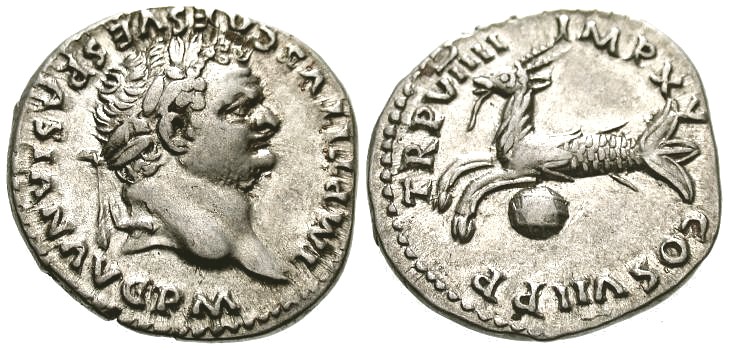
Fig.1. A Capricorn Silver Denarius (named so after the emblem on one side of the coin, on the other side celebrating the coronation ceremony of Titus to emperor in 79) seemingly similar to the coin discovered in the ruins of Pompeii (image from "A Brief Overview of the Flavian Dynasty", by L. HARSH)
- The remains of garum - a spicy fish sauce - made using the fish species Boops boops (bogue), abounding in the Mediterranean Sea from July to August, could also point to a period of the eruption sometime between late August - September.
Also some geological evidence, like the distribution of ash deposits, suggests a later eruption. The mapped ash layers suggest that during the eruption the wind blow from the east. This wind pattern is unusual for the summer in Naples, but dominant in the rest of the year.
So in the end...
"There are known knowns; there are things we know we know. We also know there are known unknowns; that is to say we know there are some things we do not know. But there are also unknown unknowns – there are things we do not know we don't know.“
Donald Rumsfeld, 2002
Bibliography:
STEFANI, G. (2006): Scoperte Campania - La vera data dell´eruzione. ARCHEO 260 - Ottobre: 10-13
ROLANDI, G.; PAONE, A.; LASCIO, M.di & STEFANI, G. (2008): The 79 AD eruption of Somma: The relationship between the date of the eruption and the southeast tephra dispersion. Journal of Volcanological and Geothermal research. Vol. 169(1-2): 87-98
Alexander von Humboldt and the Hand-Beast
The German naturalist F. W. H. Alexander von Humboldt (1769-1859) is today remembered as great geographer and explorer (maybe one of the most common names found on topographic maps is even Humboldt), but his education focused on mining engineering (and economy, as wished by his mother) and he made some important contributions to geology (for example the coined the term "formation") - however despite his interests in earth sciences, his contributions to palaeontology are rare and almost forgotten...
His geological education made him aware of the controversy surrounding the origin of fossil molluscs (still considered more as curiosities than valuable stratigraphic tools) and large vertebrates found in the Permafrost soils of Siberia. In 1789 he had the opportunity to have a look on the first fossil pterosaur skeleton.
During his famous expedition to America (visited from 1799 to 1804) he collected fossil bones and sent them to palaeontologist Cuvier. He also collected fossil molluscs for fellow German geologist Von Buch, and he even directed paleontological excavations near Bogotá.
In 1833 the school director and amateur archaeologist F. Sickler noted some strange depressions in a slab used in the laying of the foundation wall of a small garden house in the village of Hildburghausen (Germany). The slab was badly damaged and Sickler was not sure what this strange fossil may be. Sickler promised to the workers in the local sandstone quarries a reward if they could provide a better specimen - and so one year later Sickler was able to publish a short account on a new slab with three distinct types of footprints, maybe from some ancient amphibious animal. He "invited" the greatest geological minds of the time (including Humboldt) to study this strange fossil. The discovery excited a larger public, as some imprints resembled a human hand - today these ichnofossils are known as Chirotherium ("the hand-beast").
His geological education made him aware of the controversy surrounding the origin of fossil molluscs (still considered more as curiosities than valuable stratigraphic tools) and large vertebrates found in the Permafrost soils of Siberia. In 1789 he had the opportunity to have a look on the first fossil pterosaur skeleton.
During his famous expedition to America (visited from 1799 to 1804) he collected fossil bones and sent them to palaeontologist Cuvier. He also collected fossil molluscs for fellow German geologist Von Buch, and he even directed paleontological excavations near Bogotá.
In 1833 the school director and amateur archaeologist F. Sickler noted some strange depressions in a slab used in the laying of the foundation wall of a small garden house in the village of Hildburghausen (Germany). The slab was badly damaged and Sickler was not sure what this strange fossil may be. Sickler promised to the workers in the local sandstone quarries a reward if they could provide a better specimen - and so one year later Sickler was able to publish a short account on a new slab with three distinct types of footprints, maybe from some ancient amphibious animal. He "invited" the greatest geological minds of the time (including Humboldt) to study this strange fossil. The discovery excited a larger public, as some imprints resembled a human hand - today these ichnofossils are known as Chirotherium ("the hand-beast").

Fig.1. A mid-nineteenth century fanciful view of the unknown Triassic trackmakers: a labyrinthodont amphibian leaves a Chirotherium trackway watched by some primitive reptiles (from the Benjamin Waterhouse Hawkins archive, Natural History Museum, London).
Fig.5. The mid-nineteenth century fanciful view of the trackmakers: a labyrinthodont amphibian (centre) leaves a Chirotherium trackway watched by dicynodonts (left) and rhynchosaurs (right).
(B.W. Hawkins archive,The NaturalHistory Museum, London), - See more at: http://historyofgeology.fieldofscience.com/2011/01/ichnofacies-associations-of-bletterbach.html#sthash.l4qakhYF.dpuf
(B.W. Hawkins archive,The NaturalHistory Museum, London), - See more at: http://historyofgeology.fieldofscience.com/2011/01/ichnofacies-associations-of-bletterbach.html#sthash.l4qakhYF.dpuf
In a note read to the Academy of Sciences of the Institute of France in the year 1835 Humboldt made public his opinion on the mysterious fossils of Hildburghausen. He considered the imprints as real fossil trackways (some geologist, like Von Buch doubted at first this interpretation) and he considered the ancient trackmaker more similar to a mammal than an amphibian. Based on the toe configuration, Humboldt imagined at first a marsupial, possibly an arboreal possum-like creature (this idea was based on the imprint of - what Humboldt tough - an opposable toe in the Chirotherium tracks). Despite an expert in reptilian anatomy (he had observed caimans along the shores of the Orinoco and studied a Nile crocodile in an Italian collection) he didn´t recognize any similarities between Chirotherium and modern reptilian footprints. The identification of Chirotherium as fossil mammal tracks was at the time a scientific sensation, at it would have significantly pushed mammals into deep time (from the Tertiary to the Triassic).
However Humboldt´s analysis attracted little interest by contemporary naturalists and the opinion of British palaeontologist Richard Owen - Chirotherium made by a larger reptile - prevailed. In fact even Humboldt in his later work "Cosmos" (published in various volumes between1845-1862) doesn´t mention his research on ichnofossils and even notes that the earliest mammals are found only in Jurassic sediments.
It´s not entirely clear why Humboldt, famous for his general interest in all earth sciences, showed so little interest in this subject. Maybe he considered his knowledge too limited, as his preliminary analysis was based only on a specimen displayed in the mineralogical cabinet of the Natural History Museum of Berlin, to engage in a scientific discussion. Maybe he was also more interested in presenting this puzzle to the scientific community, awaiting that others should solve this ancient mystery.
Bibliography:
KNOLL, F. (2009): Alexander von Humboldt and the hand-beast: A contribution to paleontology from the last universal scholar. C.R. Palevol Vol.8: 427-436
Bibliography:
KNOLL, F. (2009): Alexander von Humboldt and the hand-beast: A contribution to paleontology from the last universal scholar. C.R. Palevol Vol.8: 427-436
Happy Easter with a (fake) Dozen Dinosaur Eggs
 Roy Chapman Andrews was not only an intrepid explorer and palaeontologist, but also a gifted promoter. The Central Asiatic Expeditions in search of fossils of mammals and dinosaurs were accompanied by movie cameras to film their work. As the conditions were most time prohibitive -sandstorms, burning sun and arid climate - many scenes showing the discovery and excavation of fossils were probably staged after the real work had be done.
 Many photos of the expedition-photograph John B. Shackelford show dinosaur nests filled with "Protoceratops*"eggs (*in fact Oviraptor eggs), superbly preserved. It seems unlikely that the eggs were in such good shape when first discovered. More strange is the common notion in popular culture that the nests contained exactly a dozen of eggs, believe probably influenced by photos of reconstructed nests.
In fact in Andrews's descriptions the number of eggs per nests varies, from three to nine, only in one case he mentions thirteen eggs, however embedded in a block of sediment.

Bibliography:
DAVIDSON, J.P. (2008): A History of Paleontology Illustration. Indian University Press, Bloomington: 217
Tiny Plants Creating Big Rocks
Often enough the rocks determinate the presence and distribution of plants (as shown in the wonderful blog "In the Company of Plants and Rocks"), but sometimes it's the plant shaping the rocks.

Plate showing the deposition of travertine* around single algae cells (ca. 1935). The high content of carbonic acid (white circles) dissolves carbonate (shown as schematic rhombohedra-crystals). Plants (like this alga) use the carbon dioxide for their metabolism and the water becomes less acid, the carbonate is deposited around the plant tissue. The final figure shows the soft water, with less dissolved carbonate.
The upper caption reads:
"Tiny Plants
built the Travertine of Polling**
Substance in the water, they found
Sun gave them power"
This plate was drawn by the German Prof. Dr. Gustav Dunzinger (1868-1940), pharmacist and plant-physiologist. Dunzinger dedicated himself also to scientific-botanical illustrations.
built the Travertine of Polling**
Substance in the water, they found
Sun gave them power"
This plate was drawn by the German Prof. Dr. Gustav Dunzinger (1868-1940), pharmacist and plant-physiologist. Dunzinger dedicated himself also to scientific-botanical illustrations.

Fig.2. Outcrop with travertine investigated by Dunzinger, old quarry near the German village of **Polling.
*Travertine is the general term in Germany for continental limestone, however in English it is referred to limestone from hot springs or deposited by inorganic processes. Calcareous tufa forms by precipitation of calcium carbonate from “cool” springs and river waters, helped by organic processes - the travertine of Polling is therefore a tufa.
Subscribe to:
Posts (Atom)