Field of Science

Fakes, Frauds and Fossils: The Lying Stones of Dr. Beringer

In 1725 the amateur palaeontologist Dr. Johann Bartholomäus Adam Beringer (1667-1738), personal physician of the bishop and superintendant of the renowned Julius-infirmary of the city of Würzburg, was approached by three youngsters, who offered him some strange stones, which they have found, to buy. Beringer was enthusiastic, paid a rich recompense for this and further discoveries, and in short time possessed the greatest collection of these rocks, depicting bugs, molluscs, plants, birds, mammals, stars and suns, and even Hebraic letters.
In 1726 Beringer published a monographi
c work, with 21 plates depicting 204 of the rocks and describing them in 14 sections: the "Lithographia Wirceburgensis".
But then the scandal was r
evealed, the youngsters admitted that the rocks were a fraud carved by themselves, incited by two colleges of Beringer, the mathematician Jean Ignace Roderique (1697-1756) and the librarian Johann Georg von Eckhardt (1664-1730), who in this way perpetuated their revenge on the presumptuous Beringer. Roderique and Eckhardt had finally to leave the city, and Beringer tried to minimize the damage by repurchasing all the printed copies and destroying the print-plates, but his reputation was irreversible lost.

This post is a tentative submission to "The Giant´s Shoulders" Blog Carnival

In other versions of the story it was only a joke of students, or Roderique tried to eliminate his concurrent in a secret love to Beringers wife, or the potters of the city fabricated the rocks of clay just for fun.
The objects of the story, the beautiful carved limestone-rocks (limestone of the Obere Muschelkalk format
ion), reached worldwide paleontological fame as "Würzburger Lügensteine" - the Lie-Stones of Würzburg. But like in every myth there is only a spark of truth in this historical tale.

Fig.2. Figure of some of the "Lie Stones" showing what seem´s to be comets or stars.

A carefully research on the stones itself and t
he still existing documents of the process depict a much more complicated and intrigued "case."

The first stones were brought to Beringer on May, 31. 1725, in the same years between June and November the brothers Hehn, the youngling
Zänger and later a fourth person, which name is not recorded, collected further stones on the presumed locality of the first discovery.
Today 434 lying stones survive, 494 are depicted in the "Lithographia Wirceburgensis", and Beringer claims that he possesse
d in sum more then 2.000, but it is more reasonable to assume that the number lies between 600 to 1.100 specimens, considering the short period of the "findings".
Beringer began to describe and prepare the plates of the discovery still in 1725, and published a preview of his work in
October. To critics on the authenticity of the stones he replied with the eye-witnesses of the findings, also he confirmed that for him the stones were natural objects, but not necessary true petrifactions of organisms.

Fig.3. Frontpage of the Lithographiaea Wirceburgensis.

Beringer discuss these considerations more in detail in the first chapters of "his" Lithographia (in fact the book is published under the name of one of Beringers students - Georg Ludwig
Hueber, as doctoral thesis, but it is accepted that his contributions are limited on a introduction chapter of 9 pages), he proposes various possibilities of the formation of the stones, but dismiss them in favour of gods intervention (the work was also dedicated to the bishop, a man of the curch) and he states that the stones differ from the fossils found usual in the Muschelkalk.
Also the recognizable carving spurs (!) on the stones are only a trace of the power of god creating these figures.

In spring of 1726 Beringer buys some rocks from the fourth youngster, this time in fact fabricated by Roderique to re
veal the artificial nature of all the stones. This time the fraud is revealed, even in the presence of the bishop, but Beringer simply modifies some chapters of the Lithographia, still in press, to reply to the critics of the artificial nature of the stones, and enforcing their "natural" formation by (literally) God's hand.

In the process after the publication of the final draft the incriminated youngsters admitted only to have sold the stones to Beringer, but not to have carved it. Also the depiction of exotic animals and letters, the quality of some of the carvings seems to outreach their possibilities.
Roderique arrived to Würzburg only in the winter 1725-1726, so he can not be incriminated for the first generations of stones recovered in the year 1725.
Roderique left Würzburg in 1730 by his own choice, the "scandal" had no influence whatever on his career. The role of Eckhart in the affair is dubious, not even proven in any way.

And Beringer? Beringer not only didn't even try to prevent the publication of the Lithographia after the first claims of fraud (there was still plenty time left), but after "the scandal" re
tained his position and reputation, and published further books (but this time without geological content).

Fig.4. More Lie stones, depicting copulating frogs ?

In 1767 a second edition of the
Lithographia was published with the original plates (not even touched by Beringer) of the first edition.

Beringer didn't suffer any disadvantages of the scandal, on the contrary, without continuing debunking efforts and critics his book at the time would have been regarded as a great work, not in contrast to the general explanation for true petrifactions (still regarded created by some mystical force), but as a prove of god's almighty power.

In the end Beinger had much to achieve, and little to lose, an important motif - so a new suspicious emerge in the case - could it be that Beringer itself carved the Lying Stones?
Maybe he could remain so unimpressed by the prove that the latter stones were fakes, by knowing that nobody could definitely prove that the first generations of stones were fakes, simply because he was the only one to know exactly who forged them?

Fig.5. The Hebraic letters.

References:

BEHRINGER, J.B.A. & HUEBER, G.L. (1726): Litographiae Wirceburgensis, ducentis lapidum figuratorum, a potiori insectiformium, prodigiosis imaginibus exornatae specimen. Würzburg 1726.
NIEBUHR, B. & GEYER, G. (2005): Beringers Lügensteine: 493 Corpora Delicti zwischen Dichtung und Wahrheit. Beringeria Sonderheft 5, Teil II: 188


Online Ressources:

BibliOdyssey (15.08.2006): Fossil Fakes. Accessed 14.08.2010
A possible alternative origin of Tsunamis

Tsunamis - the harbor wave- are regarded a dangerous phenomena caused by seismic events or submarine landslides - now a research by VILIBIC et al. 2010 has focused on a Tsunami that on May 7., 2007 flooded diverse Bulgarian cities on the coast of the Black Sea, but possibly was not preceded by any of these geological trigger - factors.

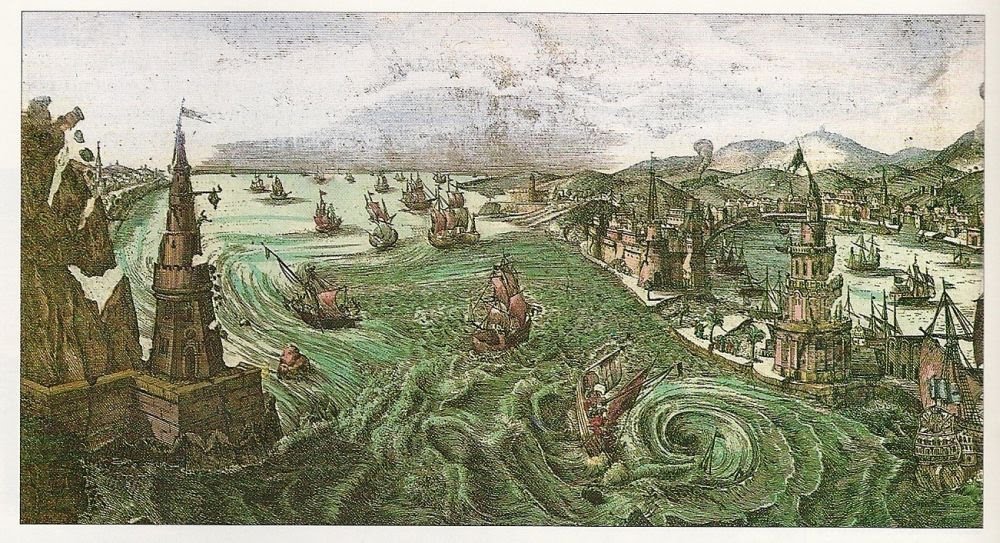
Fig.1. An earthquake and resulting Tsunami destroys the Italian city of Reggio Calabria in 1783 (Trustees of the British Museum, London).

The research proposes that the 4m high waves that damaged the coastal villages and cities were caused by the atmospheric circulation above the sea. According to a simulation of the Bulgarian Tsunami, on the 7. May the weather was fine, 18°C, sunshine, weak wind, but then cold air blocked warmer air and forced it to rise higher. The resulting air vortices converted energy to the surface of the sea, until the waves became swinging in tact with the air waves, the system now was enforcing itself until the waves reached a smaller bay, and the waves began to tower on each other and increment in height.

This interpretation is controversial; a former study by RANGUELOV et al. 2008 identified a possible landslide as trigger of the Bulgarian Tsunami, also if weather can trigger Tsunamis ,such phenomena should be observed on a much larger scale and higher frequency.


The new research nevertheless mentions diverse possible "Meteo-Tsunamis":

- in 1954 Chicago is invested by a wave that killed 5 people
- on 21, June 1978, the Croatian locality Vela Luka is hit by a wave
- in 1979 a wave killed some people in the Japanese city of Nagasaki
- in 2006 a wave hit's the island of Menorca causing havoc
- in 2007 and 2008 4m high waves flood localities on the Adriatic Sea


The authors propose even that the Tsunami in concordance with the eruption of the Krakatau in 1883 was not primarily caused by the collapse of the volcano, but by the explosion and resulting sound, sound is in fact a pressure wave, heard up to 5.000 kilometres and measured around the globe. This hypothesis according to the research could also explain why the water-wave, carried by the pressure-wave, reached so fast the surrounding coasts killing more than 10.000 peoples.

References:

RANGUELOV, B.; TINTI, S.; PAGNONI, G.; TONINI, R. ZANIBONI, F. & ARMIGLIATO, A. (2008): The nonseismic tsunami observed in the Bulgarian Black Sea on 7 May 2007: Was it due to a submarine landslide? GEOPHYSICAL RESEARCH LETTERS, VOL. 35, L18613: 5 doi:10.1029/2008GL034905
VILIBIC, I.; SEPIC, J.; RANGUELOV, B.; MAHOVIC, N.S. & TINTI, S. (2010): Possible atmospheric origin of the 7 May 2007 western Black Sea shelf tsunami event. JOURNAL OF GEOPHYSICAL RESEARCH, VOL. 115, C07006: 12 doi:10.1029/2009JC005904


Geology history in caricatures: Lyell's time circles

After naturalists realised that species can become extinct, they tried to find an explanation for the apparent succession of animals in the geological record.

In 1717 the French naturalist Buffon proposed an elaborated view of the history of earth and life: phases of stability and prosper are disrupted by single disasters, from which new life is born. This idea of catastrophism developed and survived until the 19th century.

Meanwhile for the geologists the stratigraphic succession was not a linear record, but like the annual revolution of earth around the sun a cyclic event.
John Playfair (1748-1819), Scottish geologist and mathematician, summarizes the ideas of his friend, the geologist Hutton (1726-1797):

"The geological system of Dr. Hutton, resembles, in many respects, that which appears to preside over the heavenly motions. In both, we perceive continual vicissitude and change, but confined within certain limits, and never departing far from a certain mean condition, which is such, that, in the lapse of time, the deviations from it on the one side, must become just equal to the deviations from it on the other. In both, a provision is made for duration of unlimited extent, and the lapse of time has no effect to wear out or destroy a machine, constructed with so much wisdom. Where the movements are all so perfect, their beginning and the end must be alike invisible"
(pag. 431-432 The Works of John Playfair 1822)

For Hutton the unconformities found in the stratigraphic record prove that sediments are deposited in the sea, become mountains, were eroded and the debris is transported back into the sea - an eternal cycle of formation and destruction of which fossils are a part.
It's thanks to the work of Playfair (1802) "Illustrations of the Huttonian Theory of the Earth" - in which he explains in a "simplified" form the idea of Hutton. who was known for his reader-unfriendly style of writing - that the hypothesis of '"uniformitarianism" became widely known and was finally revived, expanded and promoted by Lyell (1797-1875).
Not disasters and rapid changes formed the earth, but slow processes of deposition and erosion, also seen acting in modern times (hence the often synonymous used term "actualism"), needing thousands, if not millions of years (the age of earth was still discussed).
Lyell also adopts the idea of geological time as a cycle. He compares the history of the earth and the climatic changes that have occurred with a "geologic year", with fall, winter, spring and summer - as ordered and similar to the cyclical movements of earth around the sun.
Animal and plant species were perfectly adapted to these "geological seasons". Lyell denied in principle the possibility of extinction, he regarded the apparent patterns in the fossil record as an artefact of the very imperfect preservation of the stratigraphic column, also if a "geological" season ended, some animal and plant species did diminish in abundance (making it more improbable to become fossilized), meanwhile others flourished, a pattern reversible at any time.
According to Lyell so it was possible that

"Then might those genera of animals return, of which the memorials are preserved in the ancient rocks of our continents. The huge iguanodon might reappear in the woods, and the ichthyosaur in the sea, while the pterodactyl might flit again through the umbrageous groves of tree ferns."

That mammals during certain geological periods were not the dominant group was just the fault of the climate, unfavourable for their development, but favourable for reptiles or fish. The discovery of mammalian bones in Mesozoic, known hitherto only in more recent sediments, seemed to confirm Lyell's idea and it was not inconceivable that one could find even more ancient mammals.

This vision of cyclic time inspired one of most famous caricatures in palaeontology. In the same year in which Lyell's "Principles of Geology" was published (1830), in the introduction of a book about natural oddities prominently figured "Professor Ichthyosaurus", lecturing to his fellow reptilian students.


Fig.1. "Awful Changes. Man Found only in a Fossil State - Reappearance of Ichthyosauri." - "A lecture, - 'You will at once perceive,' continued Professor Ichthyosaurus, 'that the skull before us belonged to some of the lower order of animals; the teeth are very insignificant, the power of the jaws trifling, and altogether it seems wonderful how the creature could have procured food." The caricature by De la Beches of Charles Lyell as Prof. Ichthyosaurus on the pages of Francis Trevelyan Buckland (Son of William B.). "Curiosities of Natural History".

The caricature was drawn the geologist Henry de la Beche (1796 -1855), who imagined a palaeontology lesson in a distant future, in which, after a climate change, as inferred by the tropical vegetation in the background, giant marine reptiles discuss the inferiority of strange creatures with weak jaws and small teeth - the mammals, who have lost heir dominant role during the ice age period.

References:

HALLAM, A. (1998): Lyell's views on organic progression, evolution and extinction. In: BLUNDELL, D. J. & SCOTT, A. C. (eds) Lyell: the Past is the Key to the Present. Geological Society, London, Special Publications 143: 133-136.
LYELL, C. (1830-1833): Principles of Geology, Being an Attempt to Explain the Former Changes of the Earth's Surface, by Reference to Causes Now in Operation. 3 Vols. Murray, London.
PLAYFAIR, J. (1802): Illustrations of the Huttonian Theory of the Earth.

Power Balance Crap and Crystal Magic

The Italian Antitrust agency (who controls the business practices adopted in commercial concurrence between societies) has initialized an investigation against a business (Sport Town with his Italian distributor Power Balance Italy) that sells Power Balance bracelets and necklaces made of silicone, claiming that it's enforce physical strength and equilibrium sense. The main accusation is misleading advertisement regarding the properties and the effects of the product to trick consumers in buy it.

The two societies promoting the talisman have time until 18. August to furnish a scientific documentation proving the claimed properties, the biological effects and that the use of the talisman has no side effects. Superfluous to say that the probability of positive results is very remote.


This case is only the last example of a long list of electromagnetic devices, claiming to be able to alter the energetic fields of the human body and have medical effects (so it´s not even original as idea).

However the believe of magic powers of talisman is a very old one, and such (crystal-) powers are also attributed by esoteric movements to different rocks and minerals. It's highly probable that as geologist you at least once was asked if and how minerals work on the human body (it happened to me).


Most Gem and Mineral Show today are dominated by people that sell the same bunch of minerals artefacts at least referring to the imaginary power of the rocks.
This wouldn't't be such a problem if there was a sincere reference to the obvious explanation: it has to work because I want to believe so; superstition is widespread and also a powerful "force", this is known as Placebo-effect.

But unfortunately our primitive instincts conflict with our rational mind, on the one side we believe weird things, but at the same time demand a rational explanation.
Most seller of this crap (some believing it, the most probably not) so pick from scientific research what confirms their presumptions, but rejecting all the evidence that dismiss it.
Regarding minerals one of the preferred explanations invokes the influence of the regular atomic structure of crystals on energy-fields, not specifying even what these fields should be. But most minerals used in crystals therapies are not even magnetic, or conduct current, have also no influence whatever on fields or not more that ever piece of matter in the universe. The most used rocks and minerals are also very common, like quartz in his various varieties, it would more reasonable that simply standing on the ground there is more effect on your body.


The Darwinius haunted world: What we can learn about science communication from the IDA-Hype

"The P.R. campaign on this fossil is I think more of a story than the fossil itself"
Matt Cartmill

Brian Switek, the well-known freelance science-blogger and author published a paper in which he analyses the relationships between science blogs, media and paleontological news-release based on the IDA case – considering the collection of opinions on the geosphere I think it’s an appropriate addition to the discussion of the role of blogs in science business.


After May 19, 2009 the announcements of Darwinius masillae as an genuine impersonator of the two branches leading to early primates and anthropoid progenitors was enforced by the general media, who indiscriminate adopted catchwords like "sensation", and last but not least the "discovery" of THE "missing link".

Aside the discussion of the exact position of D. masillae in the evolutionary tree, the story displays the intricate relationships and conflicts between science communication, the interest of researchers to promote their work, the interest of media to sell their news, and genuine science as tool to interpret the facts.
D.masillae got a professional marketing strategy, despite the perfect chosen genus name in the year celebrating Darwin, it got a catchy nickname (but to be honest that's not so unusual in palaeontology, remember Lucy) and it got media coverage in form of articles, documentaries, online appearances ( under the official website “The Link” !) and books before and after the announcement.
The Museum of Oslo was not new to such tactic, in a earlier case - the plesiosaur remains denominate "Predator X" it was successfully adoperated, and plans were made to promote the new acquired primate fossil in a same, if not better way, even before the scientific study on Darwinius was completed.

Finally the fossil was presented to the public, even with the patronage of well-known science communicator Sir David Attenborough, in a form that induced even many bloggers to mock about it. The news release stated following:


"WORLD RENOWNED SCIENTISTS REVEAL A
REVOLUTIONARY SCIENTIFIC FIND THAT WILL CHANGE EVERYTHING"

In contrast to the broad media coverage, the scientific paper was severely controlled by the respective media agency, and not released to journalists or the public until the official presentation.
The paper later published online itself generated some critics; the most content is of descriptive character and the results of the anatomical properties analysed for the systematic of Darwinius are not conclusive, or at best not conclusive enough to sustain the media claims.

These problems are in part the result of the professional management of the discovery, the paper was not available to extern experts or they were not allowed to discuss it and the research team was pressed to observe certain deadlines.


Switek concludes that there was and often still is a conflict between (maybe an idealized) science and personal interest. Fantastic claims can bias and damage the perception that science has in the general public (concept introduced by Carl Sagan in his “Demon haunted world”), but the case also introduced blogs as a useful tool to analyze the claims and their impact on the public, and where necessary to correct them.


It’s seems however that the MSM did not learn much from the case.
In 2009, just some months (October 2009 and then April 2010) ago the discovery of yet another "missing link" was announced - Ardipithecus ramidus (2009) and Australopithecus sediba (2010).

Fortunately this time from many comments and online discussion I read it seems that most "common people" where much more critical regarding the first claims.

References:

SWITEK, B.J. (2010): Ancestor or Adapiform? Darwinius and the Search for Our Early Primate Ancestors. Evo Edu Outreach

Online Ressources:
Figure from Darwinius masillae article on Wikipedia

History of Paleomammology: The first Mesozoic Mammals - or - the Platypus and the Phascolotherium

"That's the way Humans amuse themselves. They write books about things they don't understand, and each new book says all the others are all wrong. It's a silly game, and very insulting to the creatures they write about. Humans at the other end of the world, who never took the trouble to come here to see me, wrote books about me. Those who did come were more impudent than those who stayed away. Their idea of learning all about a creature was to dig up its home, and frighten it out of its wits, and kill it; and after a few moons of that sort of foolery they claimed to know all about us. Us! whose ancestors knew the world millions of years before the ignorant Humans came on the earth at all." The Platypus spluttered out more dirty water, in its indignation.The Kangaroo became very timid, as it saw the rising anger of the Platypus, and it whispered to Dot to say something to calm the little creature.
"A million years is a very long time," said Dot; unable at the moment to think of anything better to say. But this remark angered the Platypus more, for it seemed to suspect Dot of doubting what it said.
It clambered up into a more erect position, and its little brown eyes became quite fiery.
"I didn't say a million; I said millions! I can prove by a bone in my body that my ancestors were the Amphitherium, the Amphilestes, the Phascolotherium, and the Stereognathus!" almost shrieked the little creature."
(PEDLEY, E.C. 1899: "Dot and the Kangaroo" is an Australian child-book).

"FOSSIL MAMMALIA OF STONESFIELD: The laminated oolitic limestones of Stonesfield have yielded some of the most precious relics of the past ages of our globe - of the known vestiges of mammalian animals in the secondary formations, in other words, in deposits of an age long antecedent to the mammaliferous eocene epoch :-a fact of the highest interest to the geologist, since it carries back the existence of the higher vertebrated animals to a period of unfathomable antiquity. The mammalian remains hitherto discovered comprise, firstly, a portion of lower jaw, with teeth, of a small pachydermatous animal (the Stereognathus),* nearly related to some of the Eocene mammals, such as the Hyracotlierium and Plioloplius; and, secondly, at least seven specimens of portions of lower jaws, with teeth, belonging to very small animals, and referable to two genera. One of these is allied to the Wombat (Phascolomys), a marsupial animal of New South Wales; proving that the remarkable character of the mammalian fauna of Australia also prevailed in a very remote period, and that it is not, as some have inferred, a new order of things. The other was a small insectivorous mammal (Amphitherium), having thirty-two teeth in the lower jaw; its marsupial affinities are doubtful.

*Emmons's Dromatherium, from the Chatham C
oal-field of North Carolina, and Plieninger's Microlestes, from the Wirtemberg Bone-bed, are Mammalia of still more ancient date."
(MANTELL 1858; pag. 508-509)

N.B.: Tritylodont teeths, like described by Mantell, were discovered between 1847 and 1866 in the Keuper of Württemberg and described as genus Microlestes and Triglyphus, today the remains are attributed to the genus Tritylodon, described by Owen in 1884 from fossils of Karoo, regarded as a member of the Cynodontia.
Also the attribution of all the described fossils to Australian marsupials or monotremates is erroneous, in fact these remains are today classified as a separate mammal group, the Multituberculata s.l.

Fig.1. Phascolotherium bucklandi, from MANTELL 1859.

Fig.2. Amphitherium prevostii, from LYELL 1871.

Fig.3. Stereognathus, from OWEN 1860.

"But the remarkable fossils for which the Stonesfield slate is most celebrated are those referred to the mammiferous class. The student should be reminded that in all the rocks described in the preceding chapters as older than the Eocene, no bones of any land-quadruped, or of any cetacean, had been discovered until the Spalacotherium of the Purbeck beds came to light in 1854. […]
These observations are made to prepare the reader to appreciate more justly the interest felt by every geologist in the discovery in the Stonesfield slate of no less than ten specimens of lower jaws of mammiferous quadrupeds, belonging to four different species and to three distinct genera, for which the names of Amphitherium, Phascolotherium, and Stereognathus have been adopted.
It is now generally admitted that these are really the remains of mammalia (although it was at first suggested that they might be reptiles), and the only question open to controversy is limited to this point, whether the fossil mammalia found in the Lower Oolite of Oxfordshire ought to be referred to the marsupial quadrupeds, or to the ordinary placental series. Cuvier had long ago pointed out a peculiarity in the form of the angular process the lower jaw, as a character of the genus Didelphys; and Professor Owen has since confirmed the doctrine of its generality in the entire marsupial series. […]
The second mammiferous genus discovered in the same slates was named originally by Mr. Broderip Didelphys Bucklandi, and has since been called Phascolotherium by Owen. It manifests a much stronger likeness to the marsupials in the general form of the jaw, and in the extent and position of its inflected angle, while the agreement with the living genus Didelphys in the number of the pre-molar and molar teeth is complete.
In 1854 the remains of another mammifer, small in size, but larger than any of those previously known, was brought to light. The generic name of Stereognathus was given to it, and, as is usually the case in these old rocks, it consisted of part of a lower jaw, in which were implanted three double-fanged teeth, differing in structure from those of all other known recent or extinct mammals."
(LYELL 1871; pag. 347-348)

Fig.4. Stratigraphic range (adapted to the modern subdivision) of the fossil mammal -specimens (red bars and numbers) mentioned by Lyell in 1871.

References:

LYELL, C. (1871): Elements of Geology - the Student's Series.
MANTELL, G.A. (1858): The Wonders of Geology; or A familiar Exposition of Geological Phenomena. 7th edition Henry G. Boehn, London
OWEN, R. (1860): The History of Paleontology. A. and C. Black, Edinburgh
PEDLEY, E.C. (1899): Dot and the Kangaroo.

Ambrogio Maria Soldani - the father of micropaleontology

"In the sea-sand of Rimini… there can be found lots of ammonites and nautilus same, small, multi-chambered bivalves… So PLANCUS found in 6 ounces* of marine deposits 618 specimens of Nautilus calcar, 130 Nautilus crispus, 6700 Nautilus becarii, 900 N. raphanus and 4 N. radicula, in sum 8.452 individuals, They seem in part similar to the nummulites and other petrifaction and are been described and depicted by PLANCUS, FICHTEL, MOLL and d´ORBIGNY , but still not sufficiently investigated."
F.S. VOIGT Lehrbuch der Zoologie, 1835
*(modern equivalent 187,5g)

Fig.1. Portrait of Ambrogio Maria Soldani.

It was the Italian Abbot Ambrogio Maria Soldani (1736-1808) who as first published an extensive research dedicated to the small fossils found in the Pliocene and Pleistocene sediments of Tuscany.
Soldani was anointed abbot in 1776, four years later he bacame the superintendent of the monastery of Santa Mustiola in Siena, teaching philosophy, theology, but also chemistry and natural sciences (a not unusual combination for these times). During his career he visited and studied many geological localities in Tuscany, Central and South Italy, also in Germany and Austria.

In 1780 he published a preliminary "Saggio Orittografico" (The Written report), where he describes various fossil bearing localities and explains the geology of Tuscany. The “science of shells” impressed his contemporaries, and the earl of Tuscany, Pietro Leopoldo, nominated Soldani to “professor of mathematic sciences” of the University of Siena, one of the most important institutions of the time.
Soldani continued his studies and travels, but despite the preliminary success, to complete his second work he had to demand various loans and even pawn the work in progress.

Between 1789 and 1798 he published "Testaceographiae ac Zoophytographiae parvae et microscopicae”, a monumental work where he reassumed 27 years o research.
This book contains many plates with gorgeous drawings of microfossils as they appear under the microscope (see figures 2. and 3.). Among them, many Foraminifera were illustrated.

In his study of rocks, Soldani noted small shells embedded into the sediments, these organisms where similar, but not identical to the shells of living animals he also found in recent sand and rocks of the sea. Nevertheless he concluded that studying the latter, it was possible to deduce the environment in which the former lived, and so doing interfere the conditions of formation of the sedimentary rocks.

Unfortunately the restricted geological knowledge of the time didn’t allow such considerations, the work was profoundly misunderstand and finally ignored. Soldani was deeply disappointed, and in an attempt to destroy his work he burned many copies of the printed book and sold the metallic print-plates of the figures to an artisan specialized in the repair of pots.
He continued his work on geology, palaeontology and even on meteorites, rocks he recognized not of terrestrial origin, but these observations only enforced the aversion against him - his reputation was ruined and his work got underappreciated.

Today Ambrogio Maria Soldani is rightly considered, with another Italian naturalist - Jacopo Bartolomeo Beccari, as father of micropaleontology.
Only a small number of animals are so well studied as foraminifers, since 1935 the research on these unicellular, widespread and stratigraphically distinctive organisms literally exploded.


Fig.2. Frontcover of the volume dedicated to Soldani by the Italian Paleontological Society for the bicentery of his dead. The figure shows various species of foraminifers as depicted in "Testaceographiae ac Zoophytographiae parvae et microscopicae."

Fig.3. Backcover, dominated by the illustrations of mollusc shells and in the first rows four foraminifers and the oogonium of an algae (Characeae).

References:


BELLIER, J.-P.; MATHIEU, R. & GRANIER, B. (2010): Short Treatise on Foraminiferology (essential on modern and fossil Foraminifera). Carnets de Géologie (2010: Livre 2 - Book 2)
Societá Paleontologica Italiana ed. (2009) : Giornate di Paleontologia - Siena, 9-12 settembre 2008. Simposio per il bicentenario della morte di Ambrogio Soldani. Padre della Micropaleontologia. Bollettino della societ
á paleontologica italiana. Vol. 48(2).
LOEBLICH, A.R. & TAPPAN, H. (1998): Foraminiferal genera and their classification - Textband und Bildband. Nostrand Reinhold Company - New York.
LOEBLICH, A.R. & TAPPAN, H. (1964): treatise on invertebrate paleontology - Part C, Protista 2. Vol.1 + 2. Geological Society of America, University of Kansas Press.
SOLDANI, A. (1780): SAGGIO ORITTOGRAFICO ovvero osservazioni sopra le terre nautilitiche ed ammonitiche della Toscana con appendice o indice latino ragionato de' piccoli testacei, e d'altri fossili d'origin marina per schiarimento dell'opera. Dedicato a Sua Altezza Reale Pie. Stamperia Vincenzo Pazzini, SIENA

RICHTER, A.E. (1999): Handbuch des Fossiliensammlers - Ein Wegweiser für die Sammlerpraxis. Bechtermünz Verlag: 461